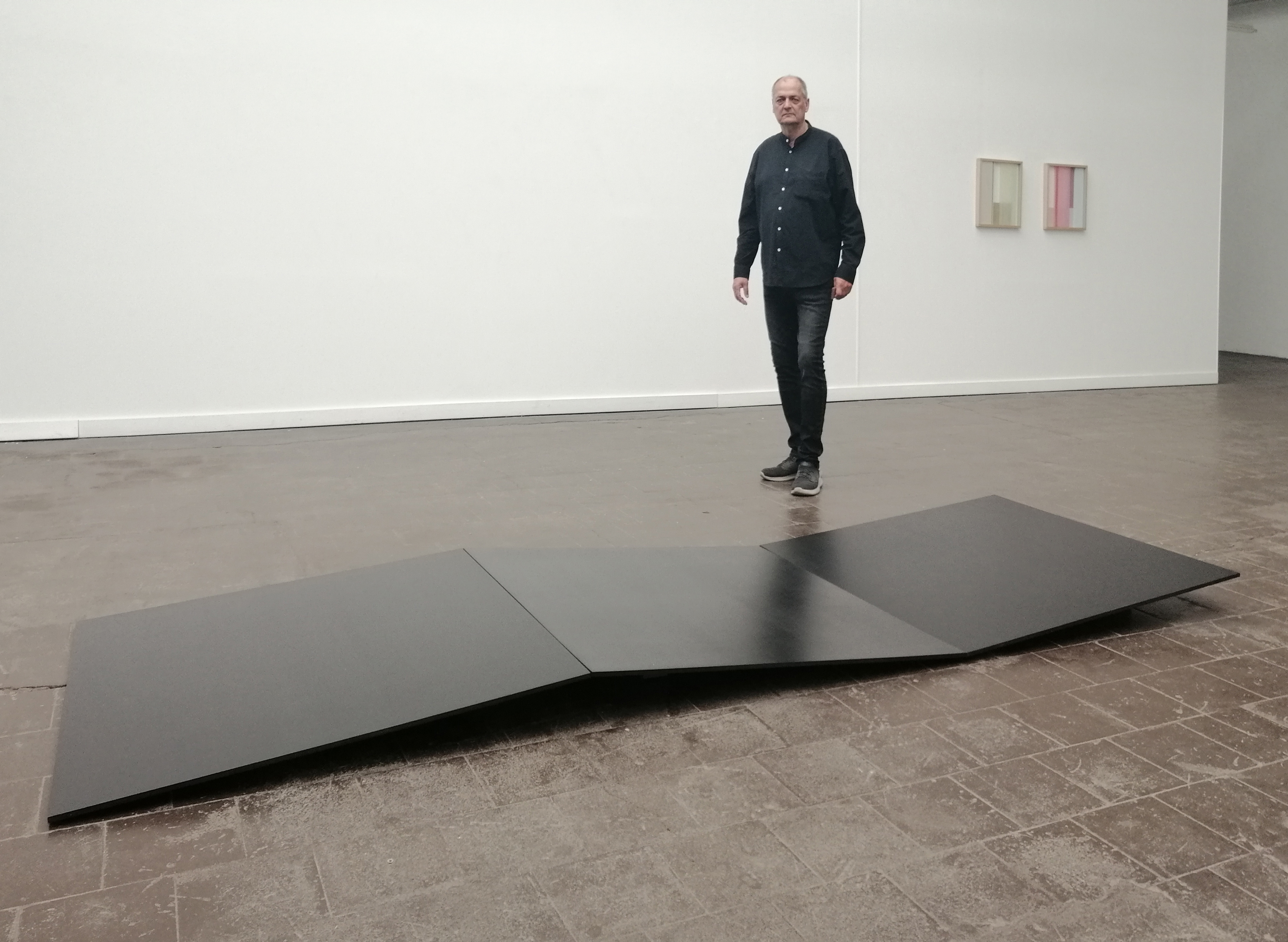
Die Bodeninstallation untersucht die Faltung als elementare räumliche Operation. Drei quadratische Platten bilden eine zusammenhängende Fläche, deren Kontinuität durch zwei gegenläufige Knicke verändert wird. Aus einer ebenen Ausdehnung entwickelt sich eine räumliche Sequenz, die weder als geschlossener Körper noch als flache Ebene erscheint, sondern einen Übergang zwischen beiden Zuständen beschreibt.
Die Faltungen definieren keine additive Konstruktion, sondern entstehen ausschließlich durch die Veränderung der Orientierung einer kontinuierlichen Fläche. Dadurch wird Raum nicht durch Volumen erzeugt, sondern durch minimale Richtungswechsel innerhalb derselben materiellen Struktur.
Die Arbeit liegt unmittelbar auf dem Boden und verzichtet auf einen Sockel oder eine hervorgehobene skulpturale Position. Ihre räumliche Präsenz entwickelt sich aus der Beziehung zur Architektur und aus der Bewegung der Betrachtenden. Mit jedem Standort verändern sich die Winkel der Fläche, die Lichtreflexionen der schwarzen Oberflächen und das Verhältnis von Kontinuität und Unterbrechung.
Die Installation versteht Faltung als konstruktives Prinzip, das Fläche nicht auflöst, sondern neu organisiert. Die skulpturale Form entsteht aus der Transformation einer einzigen Ebene und macht den Moment sichtbar, in dem sich Fläche in Raum artikuliert.
The floor installation investigates folding as an elementary spatial operation. Three rectangular panels form a continuous surface whose continuity is transformed through two opposing folds. From a planar extension, a spatial sequence emerges that is perceived neither as a closed volume nor as a flat plane, but as a transitional condition between the two.
The folds do not result from additive construction but solely from changes in the orientation of a continuous surface. Space is therefore articulated not through volume, but through minimal directional shifts within the same material structure.
Placed directly on the floor, the work avoids a pedestal or any elevated sculptural position. Its spatial presence develops through its relationship to the surrounding architecture and through the movement of the viewer. As viewpoints change, the angles of the folded planes, the reflections on the black surfaces, and the relationship between continuity and interruption continuously shift.
The installation understands folding as a constructive principle that reorganizes rather than dissolves the surface. Sculptural form emerges through the transformation of a single plane, making visible the moment at which surface becomes space.
TWO FOLD FOLDING
BERND KOMMNICK
360 x 120 x 15 cm
MDF, WOOD, PAINT
2026